Showing posts with label wildlife. Show all posts

03 February 2012

Anansi Rainbringer

Frequent visitors when rain is on its way, Rain Spiders prefer to find a warm, dry place to stay until rain passes. I believe that their "official" name is the Huntsman Spider, but we have always known them as the rainbringers.

They're supposedly quite poisonous, but their mandibles are not strong enough to bite us (or so I'm told.)

I find Rain Spiders to be quite chilled-out characters, and they are not aggressive if handled gently and calmly. We frequently let them hang around the house for ages after they've found their way in. The only compelling reason to move them back outside is if they're in a bad place - somewhere where they're likely to suffer injury or accidental death - like the inside of door jambs. Or if we have spider-nervous visitors. Hi, Dad. Rain Spiders grow quite large - as big as my palm, in some cases, if you include the span of their legs.

They're a more reliable forecaster of rain than the local weather services, and welcome in my house anytime! It also helps that they are voracious predators on moths and Christmas Beetles (and, probably, the tribe of Geckos that live in the roof and walls.)

Perhaps this one pictured above got a bit confused by the Butterfly ornament hanging on the wall?

23 September 2011

Life and Death

Warning: Graphic images ahead. Squeamish people should leave now.

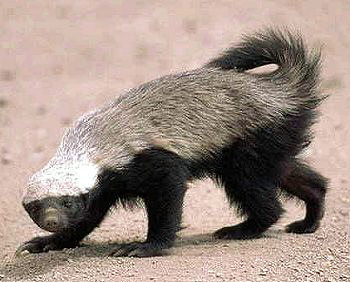
Picture courtesy of Wikipedia.
A visit by a neighbourhood Ratel (a.k.a. Honey Badger, though they're not related to Badgers at all) has dealt a severe blow to our status as Chicken growers and breeders. It's been quite a long while since the last time a Ratel managed to get in to the Chickens, but the recent visit from our other wild visitor - a Caracal - should have given me ample warning that our chook-house security needed attention. I am a bad and neglectful human person.

The night before last I was woken at about 10:30 by a tremendous bumping and banging, squawking and flapping from the chicken-house. Leapt out of bed, grabbed a light and rushed out to find a full-grown Ratel sitting in the midst of the flock. I opened the door and Ratel leapt out and vanished into the night, chased by an overenthusiastic Keira dog.

It was mayhem in there. Dead chickens all over the floor. Still, not much I could do in the dark, so I shut all up and went back to bed, only to be roused again half an hour later! Sure enough, the Ratel was back in the chook house, and, obviously spooked by the strong light destroying its night-vision, spitting and hissing at me. These animals are not to be trifled with, so I kept a wide berth as I opened the door to let it out. Utter chaos inside.

Next morning revealed the full extent of the damage.

Over the past several months we have lost quite a few chickens to neighbourhood dogs. It seems that non-permanent residents are incompetent to take responsibility for controlling their dogs in a farming area where livestock of all sorts abound.  Stock loss to dogs - including feral dogs - is a significant problem for all the farmers in the area, and many of them have a zero-tolerance, shoot-on-sight policy for unknown dogs on their land. As a result, our flock numbers were way down to only 4 hens and 4 roosters.

Our prized young rooster, horribly mutilated
by the Ratel's attack. I dispatched him quickly
and cleanly. He is tonight's supper.
Now we're down to 2 chickens. Just one rooster and a hen. Very sadly, the one young rooster, who we had earmarked as breeding stock, was severely damaged by the Ratel, and I had no option but to put him out of his pain. The Ratel had ripped the entire front of his face off, including his beak.

The other young rooster seemed, at first, to have some chance of recovery, but on closer examination I found that he was unable to breathe properly, could not drink water, and his mouth was filled with dried blood. I suspect that his tongue was gone.

Another hen I found alive, but with both eyes scratched out. Later inspection showed that her body had been badly torn in places, too.

This poor dear had had both eyes scratched
out, so there's no chance of her surviving.
I had the unpleasant responsibility, yesterday morning, of killing them all. Another rooster and a hen are simply... gone. I presume and hope that at least the Ratel ate them. What I cannot comprehend is the wanton destructiveness of Ratels. I can easily understand - and sympathise with - animals taking our livestock for food, but the sheer killing of everything that moves is beyond me. Perhaps an animal behaviourist could explain it to me.

The remaining rooster is reasonably hale and well, with only slight damage to his comb. He's looking a bit lost, though, wondering where the hell all his hens have got to.

I spent the rest of yesterday fixing the floor of the chicken house so that nothing can get in (that way) again. Until the next time...

20 June 2011

12 January 2010

Snakes Alive


Myah the little doggie alerted us to something mysterious under the carport...

At first we could not see it, but it is snake season, and pretty hot, humid weather, so they're the first thing we generally think of if we don't see anything obvious. A bit of cautious looking about by me - in my bare feet and shorts, so quite careful - and I located the snake under the bushes just behind the carport.

A quick call to my friend next door, Brett, and he popped round with his snake-catching device and bucket. Brett is well known locally as a Snake Guy, and has caught a couple of snakes around our place in the past.

Had the snake been a Boomslang (lit. "Tree Snake") we would probably have just left it alone, since Boomslang are very shy and basically non-aggressive, despite their deadly venom. Puffadders, on the other hand are very aggressive, so not a good idea to leave lurking with the dog around.

I freely confess that I am terrified of snakes. Something in my Lizzard Brain that just freaks out in the presence of a snake. So I'm very grateful to Brett for dealing with the snake for me! He releases them in remote locations where they will thrive, far away from where they're caught, since Puffadders will travel up to 5km back to the place they were.

Still, they're at least more honest about what they're about than some human snakes I've come across.

26 October 2007

The White Lions of Timbavati

Blogger for Positive Global Change AwardThat's three times, now! Three times that I've been tagged as a "Blogger for Positive Global Change". First by Sarah at Farming Friends, who tagged me months ago1, then, just in the past couple of days by James of "The Good Life" and Robbyn on "The Back Forty".  Wow! Thank you all!2  I'll take the opportunity to act on something that has bothered me for a while, now: Reading this blog it would be easy to think that the whole "self-sufficiency, sustainable future, post-peak-everything" idea is, for us, mostly about gardening. It can never be that simple.

Africa's Most Sacred People
Last night we went to a fascinating, shocking, terrible, wonderful talk/video/fundraiser in Plettenberg Bay (a schlep -- about a 50 minute drive away) presented by Linda Tucker, to raise funds and awareness of the plight of the White Lions of Timbavati.  Linda (who was at school for a while together with J) wrote an incredible book, "Mystery of the White Lions: Children of the Sun God", which we are lucky enough to own in its first edition. Her book documents her incredible, 15-year spiritual journey from international model to being named "Protector of the White Lions" by no lesser a person than the Lion Queen of Timbavati.

White Lions are considered by the High-Shamans of many tribes to be Africa's most sacred animals. According to sacred tradition they were sent by God to teach us how to become human.  It is said that if ever the White Lions disappear from the Timbavati, all Africa will die.

Science and Business
The White Lions are a genetic variation on ordinary tawny Lions, their white (and they really are snowey-white, not merely some lighter shade of brown) colouring results from a recessive gene present in the Timbavati lion population, exactly like blue eyes in humans results from a recessive gene.  They are not albinos; they are a true white colour.

Scientific estimates place the number of White Lions at less than 300 individuals. Not one White Lion is left in the wild.  The Global White Lion Protection Trust is engaged in efforts to reintroduce White Lions into the wild, and things are looking hopeful. The trouble is that, in the wild, the lions become vulnerable to criminal "hunters" who have no compunction in illegally selling a kill to some rich first-worlder3. So, ironically, keeping a lion free turns out to be quite expensive. The Trust is also trying to get various legislative measures, CITES listings and other pushed through to protect these unique Spirit Guides.  Sadly the battle is made difficult because the White Lions are not a genetically distinct species from ordinary tawny lions; they are "simply" a variety of Panthera leo. And, because Lions are not an endangered species, trade in Lions is permitted between zoos, parks, private collectors all around the world. Sadly, this means that trade in White Lions thrives, too, since they are afforded no special protection, despite the deep spiritual significance they hold.

The Timbavati lies in the Eastern part of the country, bordering the Kruger National Park. Besides being famous for the White Lions, the area is infamous for what has become known as the "Canned Hunting Industry." Wealthy landowners "farm" animals for trophy hunting. The White Lions are the most prized of these trophies, fetching upwards of US$70,000 a head. They are bred and raised in captivity, never knowing freedom, never knowing the hunt, denied the freedom of their natural homeland. They are tranquilized and constrained in tiny compounds. And then shot dead by some Brave Hunter standing safe outside the fence, to become a stuffed trophy.

The video showed several lions being "hunted" in this manner. A mature lioness, majestic in her power, awesome in her might, her beauty, confused, dazed and frightened by drugs and strangeness, tethered to a truck. Leaps into the air, screaming and twisting as shot after shot after shot after shot hammer into her...  Her cubs paw at her dead body...


I cannot imagine the worldview of a person who is comfortable with this travesty. I cannot comprehend the soul sickness that must attend such depravity. It would be all too easy to fall into the trap of hating the people who run canned hunting operations and their customers. But really I think they're no more than a manifestation of a sickness that runs deep in our western-mode society (and the whole world lives to a greater degree in that western-mode society.) The sickness that starts with us seeing ourselves as distinct from the natural world, somehow superior to it and aloof. The sickness that results in our believing that "it is up to us to save the planet" -- from the global climate change we have induced, from the poverty of the strip-mall culture, from the soul-sucking aggression of the money system, from the poisons we've spewed into our air, soil and water.

The Earth exists quite happily without us. The Earth has been self-correcting against all manner of disaster for billions of years. The Earth and her people need us big-headed monkies not at all.  The only thing that needs saving is humanity itself.


Take Action
Please click over to the Global White Lion Protection Trust website for more information than I can reasonably fit here. Make a donation while you're there, or, better yet, become a member of the Trust. Your Dollars, Euros and Yen are more powerful currencies than ours; what is a small amount for you is a large amount in Rands, and packs a correspondingly powerful punch.

I highly recommend Linda's book as a fascinating insight into the spiritual heart of Africa. Proceeds all go towards saving White Lions and reintroducing them into the wild.

Please blog about this, write about this, shout about this, talk, sing, dance about this. Help us get the word out to more and more people. Help us celebrate the fact of the White Lions.  Marketers and business-people, politicians and the bloggeratti, all are saying how powerful is this new mode of conversation, how quickly and viral a message can become.  Let us prove that power now.

As an African I beseech you to help us save our spirit guides. As an apprentice human being, I tell you that we are lost if we cannot save these White Lions -- our guardians.

They were sent here to teach us our humanity.  It seems they're not done teaching us yet.


[1] I'm practicing hard to make the SA Olympic Procrastination Squad, but am being outcompeted by the bureaucrats in the Dept. Environmental Affairs and Tourism.  I don't think it is fair that government employees should be allowed to compete for Olympic Teams.

[2] I'll tag some other blogs as Bloggers for Positive Global Change in a separate post. I don't want to stray too far from the desperate, urgent, terrifying, heart-rending message of the White Lions.

[3] Just so you don't get the wrong picture: the people running these canned-hunting operations are not impoverished AK47-wielding third-worlders trying to eke out a living anyway they can. They are extremely wealthy, powerful, well organised business people who will stop at nothing to keep their multi-million dollar a year business intact. The government is set to finally enact legislation (it's been  years in the making) in February next year to ban canned hunting. The canned-hunting industry has already made it clear that they will spend whatever it takes to fight the legislation through the courts, all the way to the Constitutional Court.  Meanwhile, I am certain, they will simply bribe their way around the law -- just another business expense -- so I doubt the law will have any real effect.

05 July 2007

The Self-Sufficient Dog

Guinea Fowl are endemic to this area, or perhaps I should say pandemic,since they additionally get housed, fed and pampered by a neighbour.  The result? A Guinea Fowl population rocketing out of control.  Many of their natural predators have been chased away by us humans so there are several flocks in the neighbourhood, each numbering fifty to a hundred birds.

They can be a Great Bloody Nuisance when they attack my Lettuces and Swiss Chard, and for a while I've been keen on shooting a few for the pot, or at least for supplementing the dogs' diet.  I've made a few half-arsed attempts to cull the flocks, but the dogs generally alert the Guineas before I can get close enough and have great fun chasing the entire flock into the air.

This morning for the first time, OB must have lucked into one. Or perhaps Myah helped her.

Happiness is a Warm Breakfast... Lucky doggie! She won't be wanting supper tonight, that's for sure.

When I first found OB gnawing on a wing, she looked very warily at me... she knows full well that she is not allowed to go after the Chickens, and this is obviously very close to the same thing to her, too.  Even after I made it clear to her that I thought she was a clever dog, and then leaving her to get on with Dinner, she was quite unsure.  In the end Hunter Genes win, though.

I would really like it if she could continue to catch a Guinea Fowl once in a while -- good for her, good for the local ecosystem to have them culled, good for the Guineas, since the weak, slow and stupid will get caught first.  (Though its an awesome thing to contemplate: Something even more stupid that a Guinea Fowl!)  On the other hand I don't want her to start wandering off into the forest to hunt, so we'll have to keep a close eye on how this all unfolds.

06 May 2007

Our Reptilian Overlords

tortoiseA couple of unusual visitors in the past week.  First was the Tortoise.  We first met her (or him -- it's hard to tell with a Tortoise) when we got back from our brief trip to Cape Town a few weeks ago. There she was, asleep beneath the staircase.  We thought that Wayne (who'd been looking after the house and Chooks)  had put her there, though we could not imagine why.  I put her out in the garden, in a safe place.
tortoise escaping
Tortoises are becoming quite rare around here.  Too much habitat loss.  Too many squashed by careless drivers.  They always seem so old and wise, to me; I wonder what they could teach us, could we but understand them.  No wonder we call them Taught Us.

Next day she was back inside the house.  We live with the doors open, mostly, and in she came, bold as brass.  Crawled under the Throne (a huge wooden chair) and got herself stuck.  To the rescue again,  I put her in a different place.  One where she is safe from lawn-mowers and weed-eaters, close to food (the veggie garden) and water.  And I thought we'd seen the last of her, because Tortoises are normally very shy and retiring.

Nope!  A couple of days ago she was back, scrabbling about on the stoep,looking for a way back into the house.  Perhaps she's looking for a place to hibernate for the Winter.  Do Tortoises hibernate?  I fished her out from behind OB's kennel, and off she went across the lawn into the long grass.  Only problem now is I'm planning to burn the grass off soon in order to get some trees and understory plants established.

Large toadThen, yesterday, composting the Brassica beds, I met this fellow who had made a home in the warm compost heap.  The picture doesn't really give a good sense of how large he (she?) is, and he was too flighty to put something familiar into the pic; he's about the size of a man's hand!  I was really careful not to hurt him with my shovel, but I'm afraid he's going to have to find a new home for a while, until I can build a new compost heap in that particular bin.

It's a bit surprising, really, how well frogs and toads thrive in my veggie patch.  I'm forever disturbing little pale tree-frogs nestling in the base of Leeks or on Cabbage leaves.  They're very welcome, though, and a good indicator of how healthy the soil and plants are.  The surprising thing is that they thrive despite the presence of at least two Herald Snakes which mostly eat frogs!

Spent the rest of the afternoon trundling my wheelbarrow back and forth with this tune going round and round and round in my head:  "Mr Froggie went a courtin' and he did ride, aaaahummmm..."

(Apologies, once again, about the crap quality of the pics.  It's just the limitations of the shite little camera we have, and no funds for a better one.)

03 February 2007

Rare Visitor

We had a very special visitor: a Knysna Loerie (Tauraco corythaix).  Loeries are very, very shy; at the slightest disturbance they move away.  As people have moved into the area, built houses, kept their packs of howling hounds, cats that "don't hunt or chase birds, really, I'm absolutely positive!" Loeries disappeared into the depths of the forest.

Knysna Loerie close-upIn the forest they live high in the canopy, and are extremely well camouflaged.  The bird books describe them as green, and, while that's true as far as it goes, their wings have a sheen very similar to satin so that they most commonly look black unless the light is just right.  The underside of their wings is a deep, rich, shimmering crimson -- very distinctive.

They are fruit eaters, and that's what attracted our visitor!  We have a mature grape-vine growing over the west-side pergola.  The vine shades the west side of the house, helping us keep cool in Summer, while losing its leaves in Winter to let warmth in when we do want it.  It creates a transition space between the lounge and outside fireplace, and also gives us some fruit -- the little bit that is left for us by the Cape White-Eyes, Bulbuls and Finches.  No serious loss, since the grapes are not particularly nice eating -- the skin is very tough and sour, though the fruity bit inside is quite nice, having a strongly raisiny, berry taste.  They might make nice raisins, but our climate is too humid for drying fruit.  Happily the grapes also brought us this beautiful Loerie.

Knysna Loeire in the Grape VineThe pictures were taken with an ordinary point-n-shoot camera -- no special lenses or anything else fancy, which should give you an idea of just how close we were to the bird.  This is extremely unusual, as they take fright at the slightest movement.  Please excuse the glare from the window in the pictures -- probably someone handy with the Gimp could clean it up, but I am totally clueless at driving those sorts of programs.

We also believe that there is a connection between the Loeries and Elephants in the forest: When, on occasion, we have walked in Elephant-inhabited areas of the forest, flocks of Loeries make an peculiar (and to my knowledge, undocumented) call which we think warns the Elephants of our approach, enabling them to slip silently away into the deep gloomy growth.

04 October 2006

Things that go Bump in the Night

 Bump

Around here Honey Badgers are a protected species.  My beehives are strapped onto metre-high posts to avoid the risk... well... the certainty of having them ripped to shreds by a Honey Badger.  Nevertheless, Honey Badgers, or Ratels, are quite common in the area, and a bloody nuisance when it comes to Chickens and other small livestock.

When we first got Chickens, we made several mistakes in our Chicken housing, resulting in a couple of near-total losses of our flock.  So Chicken House Design has eventually evolved to a Badger-Proof plan.  With oneFatal Weakness.

We humans have to close the door to the Chicken House every evening once the Chooks have gone to bed, and we have to remove the ramp that leads up to the entrance.  And every morning, we have to let the Chooks out (and feed the breakfast) and put up the entrance-ramp.

Last night we forgot.

Sometime around a quarter-to-midnight, a massive, panic-stricken squawking woke me from my deepest slumber.  Realisation of my folly hit me immediately.  Both J and I had forgotten to shut the Chickens in.  For the first time in 5 or 7 years.

Leapt out of bed, grabbed to torch ("flashlight" to speakers of American,) down the stairs as fast as sleepy legs allow.  OB the Very Clever Doggie and I to the rescue  (salvage!)  Left to their own devices, a Ratel will (and I speak from experience) run amok and kill every chicken in sight.  At the Chicken Run, several chickens running around helplessly in the semi-dark (half-moon behind the clouds.) Chickens are virtually blind in anything darker than dusklight.  I managed to catch a couple of them and put them back in their Safehouse.  Unfortunately one hen, recently gone broody, was one of those closest to the door, and I missed her, so she spent the night out, off her clutch of eggs.  Anybody care to bet whether any of those chicks survive?

Mid-morning this morning, OB the Dog (did I mention that she really is veryclever?) came to call us; she had found one of the young roosters, fatally damaged by the Ratel.  His neck was clearly broken, but not all the way through, and he was still barely alive.  Poor bugger.  I quickly and painlessly put him out of his misery, and that pretty-much determined the remainder of my morning: Plucking and Cleaning Chicken.

OB, PhD, got her favourite treat: chicken head and feet.  And we have a delicious chicken tenderising in the freezer.  I've been meaning to cull those roosters anyway!

A Job Title

In other news: Dug up the Winter Garlic - around 200 bulbs, which should see us through the year.  Some are disappointingly small. :-O  I am planning to try a Spring planting of Garlic for harvest in May/June.  I see no reason it should fail, and, if successful, means that we can easily do two Garlic plantings a year.  Yay!

Which brings me to a final point: I have recently had several people ask me "So what do you DO?"  A question I face with the utmost trepidation and hesitation, being entirely unsure how to answer it.  Why all this focus on what we DO?  Why no interest in what we ARE?

Anyway, I now have an answer to "What do you do?": "Research Gardener".

Update 5/10/06:I just tripped across a very similar story to our Honey Badger incident on one of my favourite sites - Pocket Farm: A Bump in the Night

21 September 2006

Snakes in a Tin Can


Just had a close encounter with a Puffadder (snake).  (Unfortunately no picture – everything happened too quickly.)  The Puffy was nesting in a rusty old tin can next to my Garden Tool "cupboard" and the garden tap – a place I am in and out of all day long, moving things about, shifting hoses, plant stakes, tools and seed trays.
OB the PHD (Pointy-Headed Dog) alerted me to the snake; she is always very puzzled by snakes, and wears a very different expression to her Rat-catching face.  I guess they are interesting to her, since they move about, but probably smell strange, or perhaps lack a distinctive odour. It must be incredible to have a sense of smell like a dog's.
Being terrified of snakes, I was lucky that the snake was feeling very sleepy and mellow.  It stayed in its tin can while I fetched a bucket and lid, and flipped the snake, tin and all, into the bucket with a long stick.

Brett, my snake-catching neighbour, kindly came and took the snake away to release it in the wild.

Now I wonder where the Boy snake is... :-O

17 July 2006

Noises in the Night

Well, around 4a.m., anyway.  The Baboon troupe are spending their nights close by, just in the fringes of the forest.  Baboons are diurnal creatures like us, and they tend to stick to a safe sleeping-place for a while before moving on.

Last night there was a huge shouting match between the alpha, his sidekick and some other creature.  A Leopard hunting them?  Very likely, since there is a resident Leopard in the area.  We've often heard the Baboons screeching in the night in the past, and it usually result in them moving off into another part of the forest if they feel insecure here.  Last night was the first time that we've heard noise from their nemesis - a low, "hhhnnnh, hhhhnnnh".  Calling it a "coughing" or "grunting" noise would be totally inaccurate, but the closest word we have in English.  I surmised it was the Leopard, until I heard a crash!  A tree, or very large branch breaking.  Not a breath of wind.

Elephant?

You might also like

Related Posts Plugin for WordPress, Blogger...